Chapter 30: What the card says
Reading a Sifter Card the way a recruiter reads it, and what it refuses to claim.
By Matt Lang and Bree Lang · About the authors
Where this is on Sifter: Training Floor · Sifter Card
Everything in this unit ends up on one page. Your Sifter Card is at sifter.finance/sifter/ followed by your slug, and it has two states. Private means the link shows nothing at all, only a line saying the card is private, does not exist, or the link is wrong, so that nobody can tell the difference. Public means everything on it can be read by anyone with the link, including the theses and the lines about what would have changed your mind, and the exercise pages behind each tile. There is no half-open setting. You decide when the record is ready to be read, and after that you decide what goes on it by what you do on the Floor, not by what you write on the card.
When you open your own card while signed in, a line at the top says "This is your card. Edit on the Training Floor." The card is assembled from the exercises, and nothing on it is typed in.
This chapter reads the card once from top to bottom, the way a stranger does, and ends with the list of things it will not say.
The four tiles
Under your name are four tiles in a fixed order, the Sprint, the Spread, the Quarter and the Book, and each tile has three parts: a few numbers, one featured run, and a line about what is behind the tile.
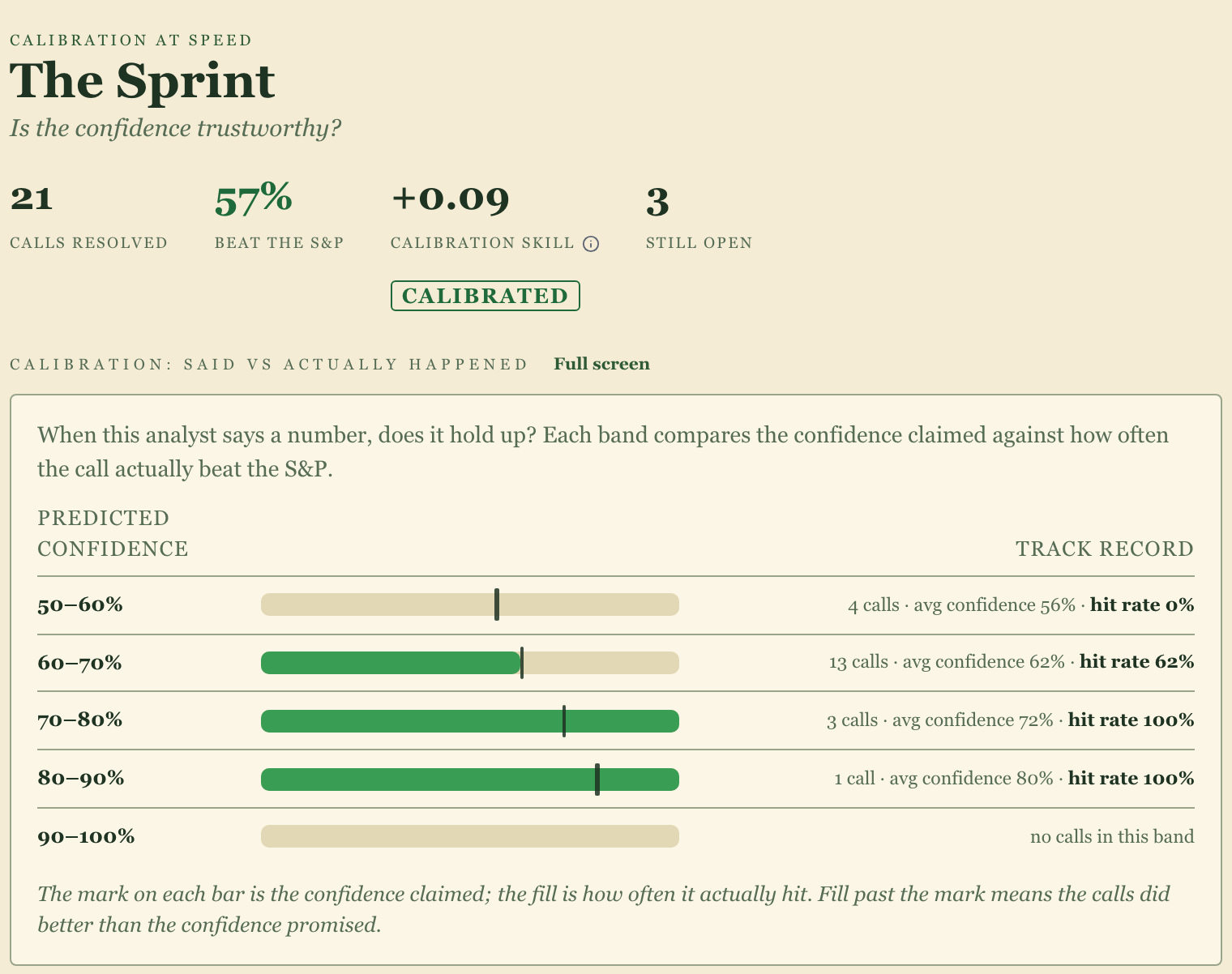
Your calibration sits at the top of the card, under your name, with its word beside it. It pools your Sprint and Spread calls, because both are probabilities on a stated event, and until 12 calls have settled it shows "building" with a count of how many have. The Sprint and Spread tiles show the same three numbers, the calls (or pairs) settled, your average confidence, and the share that came true, so the confidence you claimed sits right beside how often you were right. A short call comes true when the stock trails the S&P, which is why the tile says won rather than beat the S&P. The Quarter tile leads with your typical ratio of actual to called tracking error (1.00× means you knew how much active risk you were running), with the quarters settled and how many were on target, where each settled quarter counts 1 when both tracking error and beta land close, 0.5 when one does, and 0 when neither does. The Book tile shows how many months the book has been live.
The featured run is the one line on the card you choose. On each exercise page there is a star next to every settled call or book, and the one you star is the one the tile shows. If you star nothing, the Sprint tile shows the highest-confidence call that came good, the Spread tile the most recent settled spread, and the Quarter tile the most recent resolved book. Most readers know that the featured line is your best foot and that the page behind it holds the rest.
The three summary lines
Below the tiles is a short block that resembles a reference letter and is computed from the record. It has at most three lines, and any line without enough data behind it is left out rather than guessed.
The first line is about confidence, and it appears once eight calls have settled. It compares the average number you claimed with the share of calls that landed. If you land more often than you claim, by six points or more, it says "Under-claims confidence." If you land less often than you claim, it says "Runs a touch hot." Otherwise it says "Well calibrated," and in each case it prints both numbers next to the words. The second line, "How they bet," is built from what you actually did: concentrated or diversified by your top position, long-biased or comfortable on the short side by the mix of your calls, and whether you take market-neutral pairs. The third, "Honest about risk," counts the books on which you predicted your own risk well, and if one ran hotter than planned it says so.
None of this can be written by you or for you. A reference letter says what someone thinks of you, and this block says what you did.
The pages behind the tiles
Each tile opens a page, and the four pages are where a careful reader spends their time. You have seen each of them at the end of its own chapter, so here they are together, with what to look for on each.
The Sprint page opens with four numbers, the calls settled, your average confidence, the share won, and the calibration skill with its word under it, and a smaller line under them counts the calls still open and the post-mortems written. Then the bands, said against actually happened, and then every settled call with its thesis, its write-up if there is one, and its post-mortem.
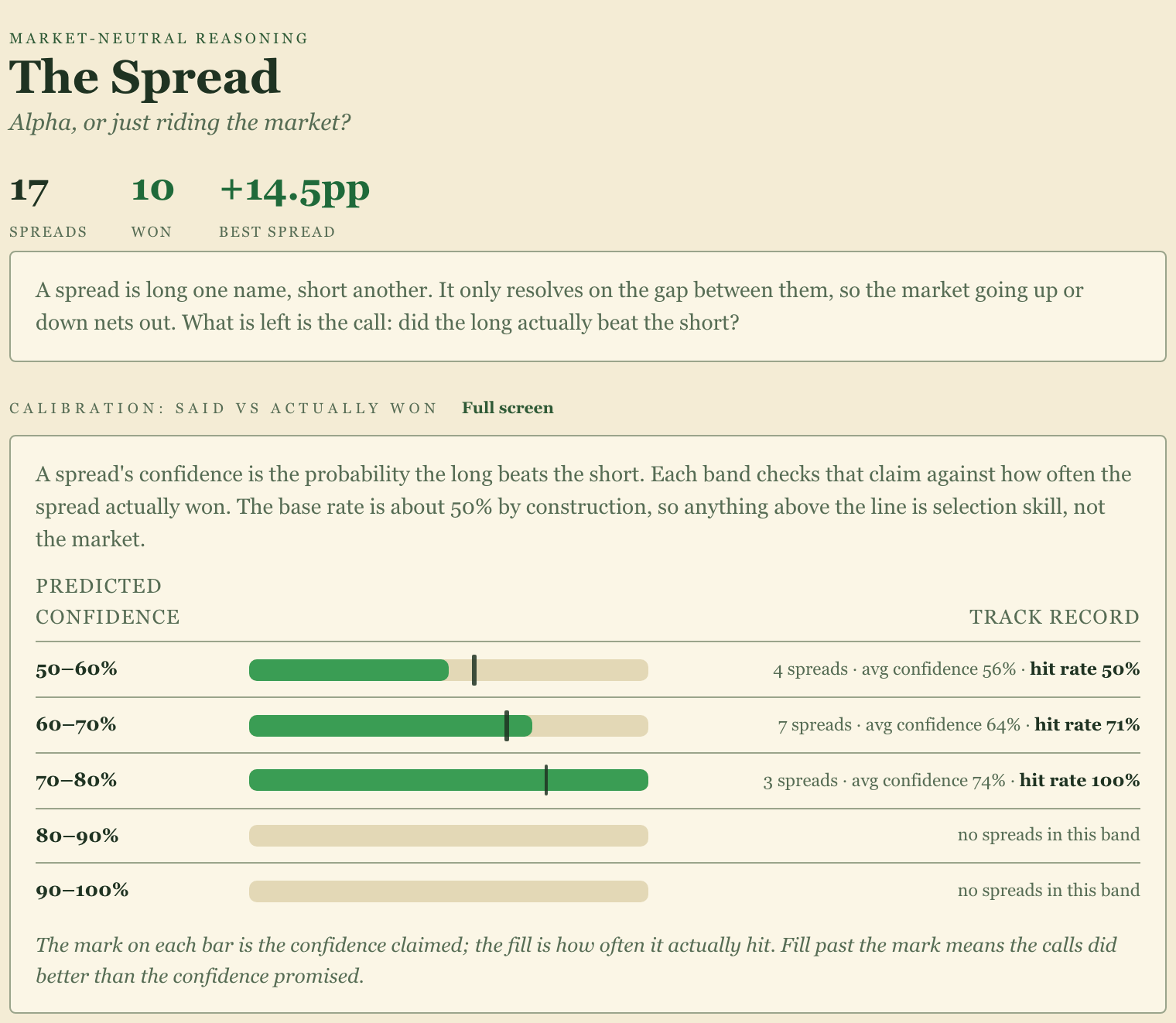
The Spread page opens with the same four numbers as the Sprint page, the pairs settled, your average confidence, the share won, and the calibration skill over the spreads alone, with the spreads still open and your best spread on a smaller line under them, then the bands as said against actually won, then the edge pair by pair as bars (the four best and four worst, with a button to show every settled spread), and then the pairs themselves with their theses.
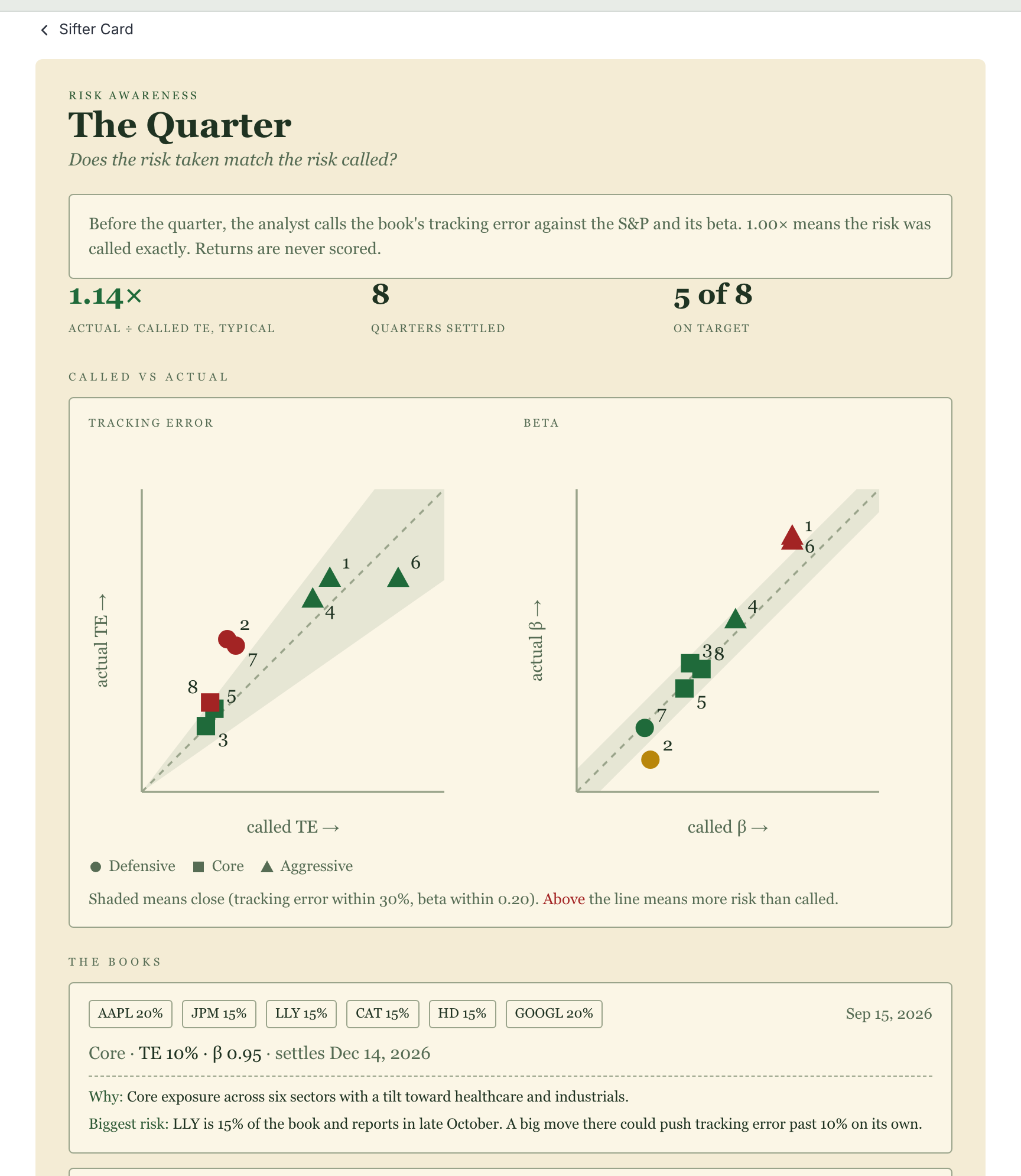
The Quarter page draws every settled book as a dot on two plots, predicted risk across and realized risk up, and then lists the books with the two lines the analyst wrote, why this book and where the risk was, and the post-mortem under them.
The Book page is the one a reader weighs most, and it is the simplest to describe. It is the mandate, the holdings, and the decision log, every buy, sell and memo with its date, its reason and how sure the analyst was. When a run ends, its post-mortem stays with it, and no run leaves the record.
Here is the order a reader who knows the platform uses. Skill and its word first, then the bands, then the count of calls and the share still open, because a record with a quarter of its calls unsettled has not finished settling. Then the misses, and the post-mortems under them, since a reader wants to know whether you can say why a call failed. Then the Book's log. The share that beat the S&P and the return column come last, if they come at all, because over two-week windows those numbers belong mostly to the market.
What the card refuses to claim
The box below lists six things the card will not say.
Everything on the card came from a sentence with a blank in it, a slider, two lines of text, and a date. The arithmetic behind the numbers is in Chapter 29, the reasons behind each exercise are in Chapters 24 to 27, and the reason any of it matters is in Chapter 23. What the card adds is that it is public, it is dated, and it cannot be written the night before.
The Analyst's Handbook is Sifter's textbook for student investors, written by Matt Lang and Bree Lang. Sifter is free for students. This chapter as markdown.